Wiv AWS Connectivity Architecture
Real-time data access and security framework for Wiv's AWS integration, detailing security architecture and data scopes for maximum optimization.
Written By Dotan Cohen
Last updated 4 days ago
Wiv AWS Connectivity Architecture
Overview
Wiv is a high-performance FinOps platform built for real-time identification of cost-saving opportunities and anomalies. By securely integrating a Cross-Account IAM Role and AWS EventBridge, Wiv delivers a unique combination of deep visibility and instant responsiveness. This document details the security architecture and outlines the complete data scopes required to achieve maximum optimization.
The Security Handshake & Guarantees
All connectivity strictly follows AWS best practices for third-party SaaS integration, ensuring maximum security and trust.
Key Security Guarantees:
Metadata Focused: Operations concentrate on metadata scans to efficiently identify optimization opportunities.
Real-Time Intelligence: Wiv utilizes EventBridge for instant reaction to account changes, eliminating the delay of waiting for daily billing updates.
Encryption & Isolation: All sensitive connection metadata is stored exclusively within your account's Secrets Manager and is never retained on Wiv's side.
No Customer Data Access: Wiv is architected to prevent access to PII, database records, or application-level data.
Ongoing access
After onboarding, Wiv calls sts:AssumeRole on WivAccessRole in your account. The trust policy allows the Wiv AWS account only when the request includes your External ID. Wiv receives temporary credentials and does not store access keys.
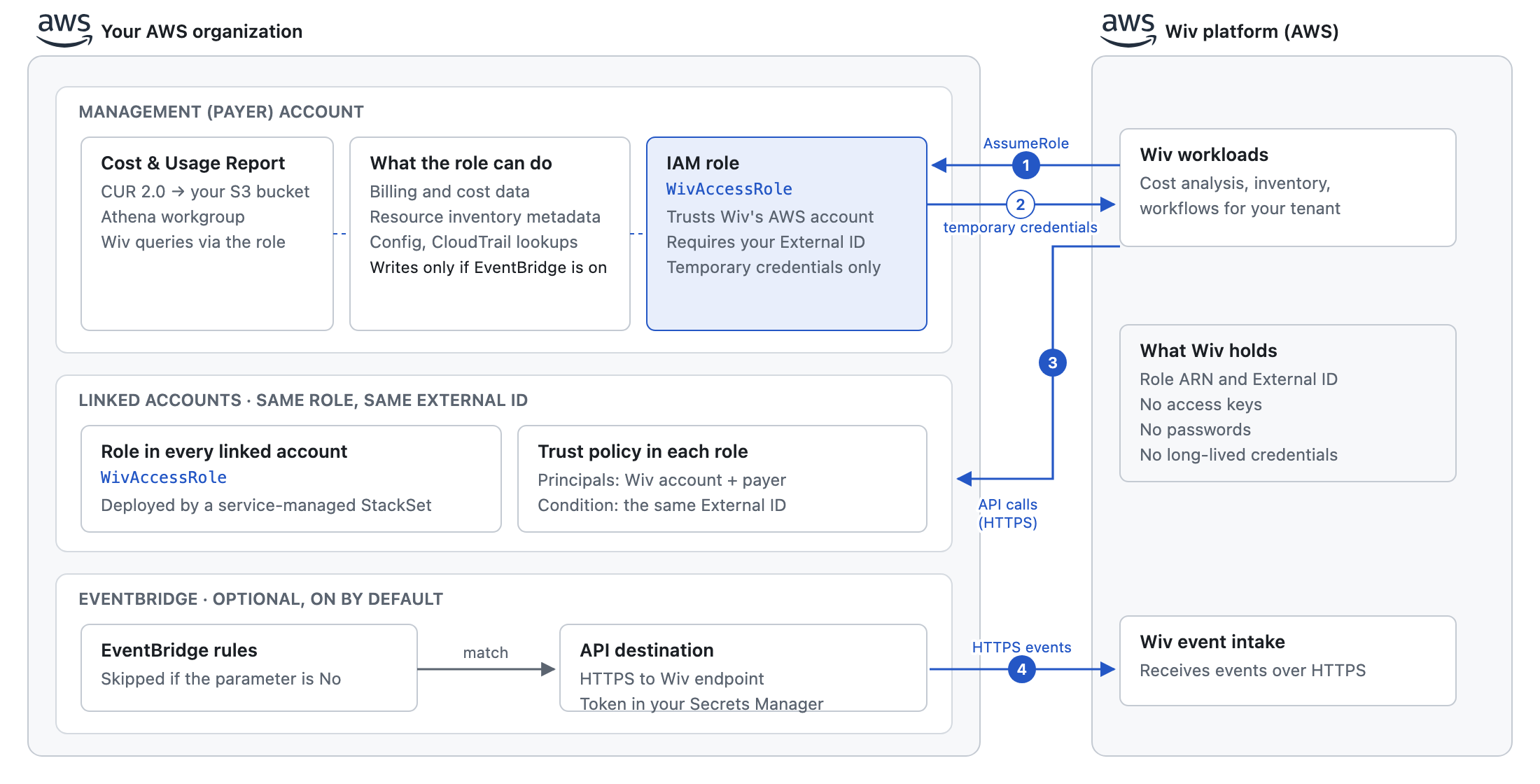
EventBridge is optional. Enable EventBridge permissions and resources (EnableEventBridge) defaults to Yes. Set it to No and the stack does not create EventBridge rules, API destinations, connections, or the EventBridge write permissions on WivAccessRole. Cost and inventory access stays.
One-time onboarding
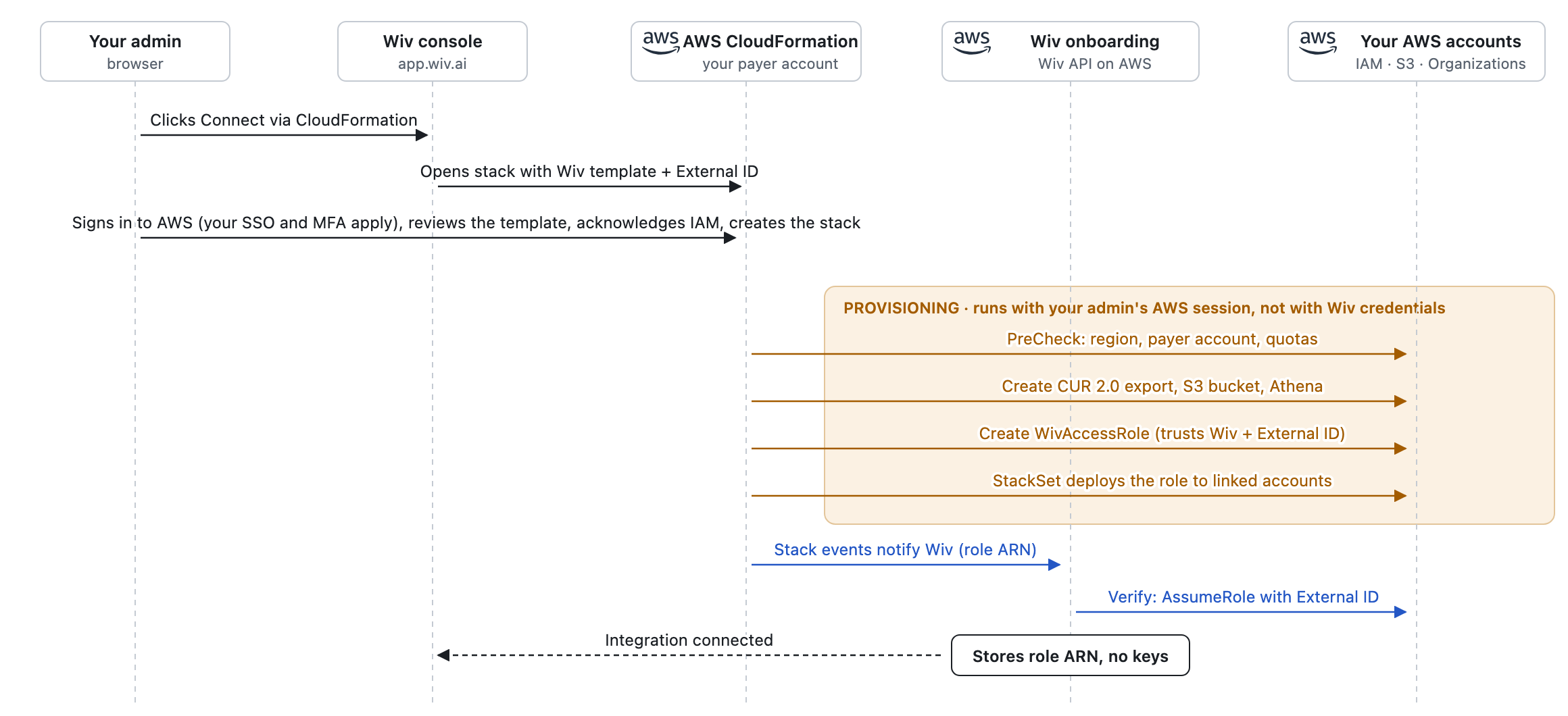
CloudFormation runs with your admin's AWS session. It runs a pre-check, creates the CUR 2.0 resources, creates WivAccessRole in the payer account, and deploys that role to linked accounts with a StackSet. Wiv stores the role ARN, the External ID, and the CUR identifiers. It does not store access keys.
The trust policy, the network path, and how to revoke access are in Wiv AWS connectivity architecture.
Visual Architecture Flow
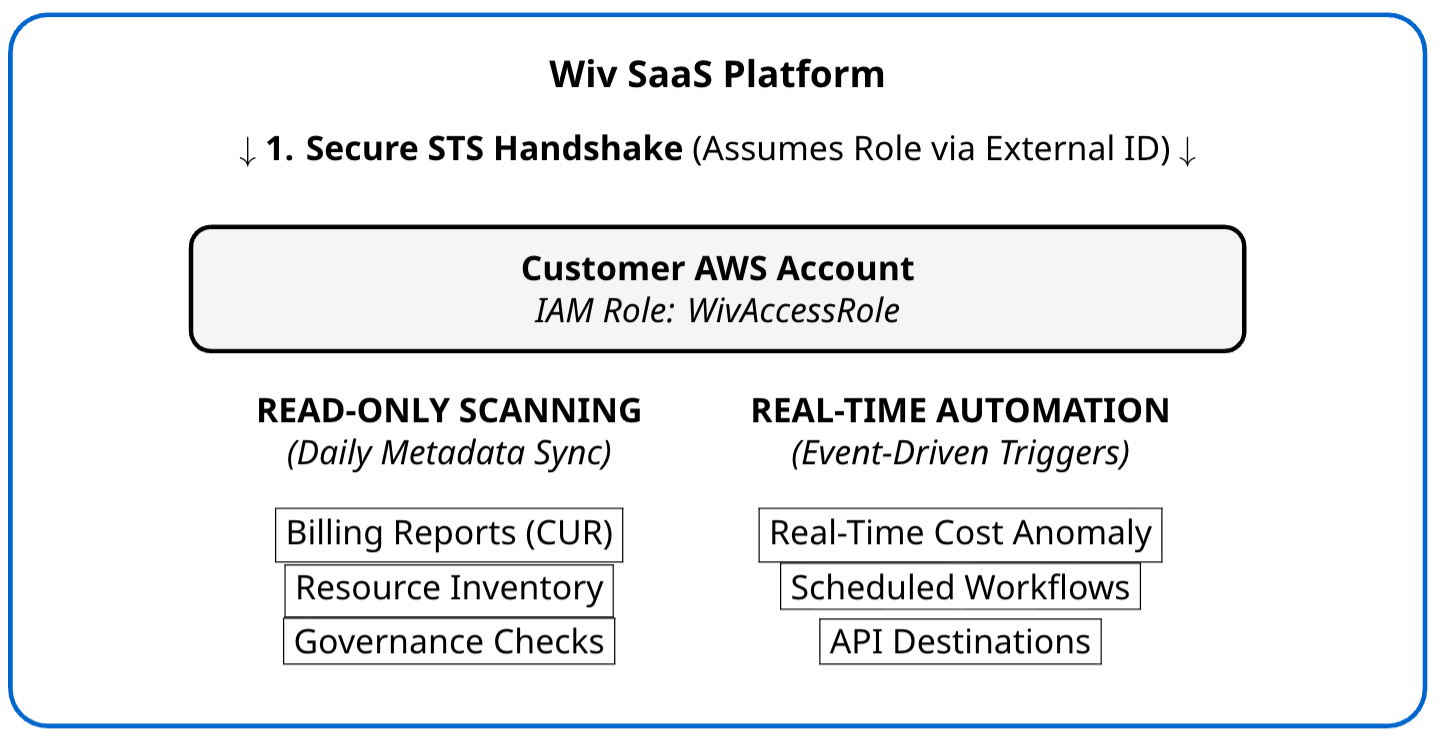
Wiv's Event-Driven FinOps: Real-Time Value and Permission Framework
The Strategic Value of Real-Time Triggers (AWS EventBridge)
Wiv's core architecture leverages Event-Driven Responsiveness, distinguishing it from traditional FinOps tools that rely on slow, periodic polling. This design enables Wiv to capture infrastructure changes instantly as they happen. It applies when Enable EventBridge permissions and resources is Yes. Set that parameter to No and the stack skips EventBridge rules, API destinations, connections, and the EventBridge permissions on WivAccessRole. Cost and inventory access stays.
Why Real-Time is Essential: Delays, such as waiting 24 hours for a billing report, can result in thousands of dollars in wasted spending due to misconfigured, expensive resources. Real-time triggers allow Wiv to immediately identify, alert on, and prevent these costly anomalies.
Mechanism: Wiv uses AWS EventBridge Rules, configuring them to "listen" for specific lifecycle events that impact cost (e.g., changes in EC2 state, creation of a new RDS instance, or activation of Billing Alarms).
Secure Data Flow: When an EventBridge rule is triggered, it securely invokes an API Destination. This pushes the necessary metadata to Wiv's backend for immediate processing.
Permission Matrix: Detailed Overview
The comprehensive table below details all API actions granted to the WivAccessRole, categorized by functional domain. These permissions are primarily read-only, supporting deep analytical capabilities.
Deep-Dive: Necessary Automation and Write Permissions
To facilitate the real-time, event-driven workflows, Wiv requires a precise and surgical set of "Write" permissions. These actions are strictly limited to managing the necessary Wiv-related infrastructure within your account for secure, real-time data integration.
Conclusion
The Wiv connectivity framework is engineered for maximum safety and transparency. By combining a broad set of read-only analytics with focused, real-time event integration, Wiv delivers a proactive FinOps strategy that catches waste before it can accumulate. Every write permission is directly tied to the security and essential data delivery of your account's metadata.
Was this helpful?
Still need help? Ask the team